Vatva, Ahmedabad, Gujarat
- GST NO. : 24AFIPJ8131Q1Z1


Posted by Commercial Solar Dryer on August, 31, 2026
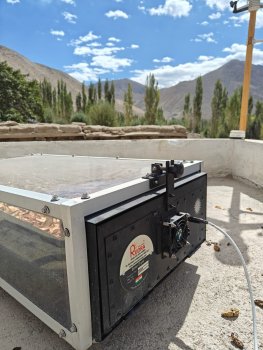
Ladakh’s short agricultural season, mountainous terrain, dispersed settlements and seasonal concentration of horticultural produce create a strong need for practical post-harvest processing. Apricot, apple, seabuckthorn, selected vegetables and herbs can be converted into value-added dried products when the raw material is prepared hygienically and processed under suitable conditions. An enclosed solar dryer in Ladakh can help farmers, SHGs, FPOs, cooperatives and food-processing enterprises reduce direct exposure to dust, insects and outdoor contamination while using available solar energy for moisture removal. However, drying time and final quality depend on the commodity, initial moisture, preparation method, slice thickness, airflow, tray loading, temperature, humidity and daily solar conditions.

Q1. Why is a solar dryer relevant for farmers and food processors in Ladakh?
Ladakh has a relatively short growing and harvesting season. When apricots, apples, vegetables and other produce become available within a limited period, growers must quickly decide whether the harvest will be sold fresh, stored, transported or processed.
Fresh produce can lose quality when sorting, transportation or market access is delayed. Mountain roads, long transport distances and the seasonal availability of raw material can make immediate fresh-market movement difficult for some growers and processors.
Traditional open-sun drying is familiar in the region, but food placed in the open may be exposed to windblown dust, insects, birds, animals and repeated manual handling. Strong wind can also disturb lightweight slices, leaves and drying surfaces.
An enclosed solar dryer creates a more protected processing environment. Heated air and designed airflow help remove moisture while the product remains inside a drying chamber. This can support more organised batch handling, improved hygiene control and better consistency compared with unprotected drying, provided the dryer is operated correctly.
Solar drying also allows suitable surplus, small-sized or cosmetically imperfect produce to be considered for processing instead of immediate rejection. Only sound, mature and contamination-free material should be selected; rotten, mouldy or fermented produce must never be mixed into a drying batch.
Q2. Which Ladakh crops and food products can be processed in a solar dryer?
The suitability of a commodity depends on its moisture content, structure, preparation requirements and intended final product. Important solar-drying opportunities in Ladakh include:
- Apricot halves, slices and selected traditional dried-apricot products
- Apple rings, slices and snack pieces
- Selected seabuckthorn leaves and properly prepared material
- Tomato slices
- Onion flakes
- Carrot and turnip slices
- Green peas after suitable preparation
- Leafy vegetables
- Culinary and herbal leaves
- Vegetable mixtures for soup ingredients
- Selected pulses, seeds or grains requiring controlled moisture reduction
Apricot and apple have particularly strong relevance because they are important horticultural products in Ladakh. Seabuckthorn also offers value-addition opportunities, but berries, leaves and processed seabuckthorn material cannot all be dried using one identical method.
Every new commodity should first be tested in a small batch. The processor should evaluate colour, aroma, texture, drying behaviour, final moisture, rehydration quality and storage stability before starting full-scale commercial production.
A single dryer may handle different products at different times, but incompatible commodities should not automatically be dried together. Products with different aromas, moisture levels, preparation methods or food-safety requirements should be processed in separate, properly cleaned batches.
Q3. How should Ladakhi apricots be prepared and dried?
Apricot is one of Ladakh’s most important horticultural commodities and has a long regional tradition of fresh and dried consumption. Local cultivars and product preferences may differ, so the drying process should be matched to the variety and intended market.
The process should begin with careful sorting. Fully rotten, mouldy, fermented, insect-damaged or contaminated fruits must be rejected. Sound apricots should be cleaned using an appropriate food-processing procedure.
Depending on the desired finished product, apricots may be prepared as halves or uniform slices after removal of the stone. Pieces with similar thickness normally dry more evenly than a tray containing widely different sizes.
Any pretreatment used to support colour or quality retention must be food-safe, suitable for the product and compliant with applicable regulations. The selected pretreatment should first be tested on a small batch because it may influence colour, flavour and texture.
Prepared apricots should be placed in a single, evenly distributed layer on clean food-contact trays. Excessive overlap can restrict airflow and leave wet pockets within the batch. The product should be inspected during drying rather than relying only on a fixed number of hours.
After drying, apricots should be cooled under hygienic conditions before packaging. Packing a warm product may cause condensation inside the pouch. Suitable moisture-resistant packaging and clean storage are necessary to protect the dried product from reabsorbing moisture.
Q4. How can apple, seabuckthorn, vegetables and herbs be solar dried in Ladakh?
Apples can be processed into rings, slices, snack pieces or ingredients for bakery, cereal and hospitality applications. They should be sorted, cleaned, cored and cut into reasonably uniform pieces. A suitable food-safe pretreatment may be considered where colour retention is important. Extremely thick pieces can dry slowly, while excessively thin slices may become more brittle than required.
Seabuckthorn needs greater process control because its berries are delicate and contain heat-sensitive components. Whole berries, leaves and prepared berry material require different handling. Selected leaves may be evaluated for controlled drying, while berry-based material may require specialised preparation or lower-temperature processing according to the intended finished product. A validated trial should be completed before commercial production.
Vegetables such as tomato, onion, carrot, turnip and peas may also be processed, but preparation is commodity-specific. Some vegetables require blanching or another pretreatment, while others may be sliced and loaded directly after proper cleaning.
Herbs and leafy products are lightweight and can be affected by excessive airflow or overloading. They should be arranged in a thin layer and monitored carefully to preserve their desired colour, aroma and physical quality.
The same time and temperature must not be assigned to every commodity. Apricot halves, apple slices, herbs and vegetables release moisture differently and therefore require separate operating procedures.
Q5. How does an enclosed solar dryer work, and how is it different from open-sun drying?
A solar dryer uses solar energy to heat the air required for moisture removal. Depending on the dryer design, solar-powered DC fans may support the movement of air through the chamber.
The general process is:
- Solar energy raises the temperature of the drying air.
- Heated air moves across or through the loaded trays.
- Moisture evaporates from the prepared product.
- Moist air exits through the designed outlet.
- Continued airflow progressively reduces product moisture.
In open-sun drying, food is exposed directly to the surrounding environment. In an enclosed system, the product remains on trays inside a protected chamber. This can reduce direct exposure to dust, insects, birds and animals while creating a more organised airflow path.
An enclosed dryer does not eliminate the need for correct hygiene and process control. Raw material still needs to be sorted and cleaned, trays need to be washed, slices must be loaded correctly, and the final product needs safe cooling and packaging.
A solar dryer should also not be treated like an instant electric oven. Its performance changes with solar radiation, ambient temperature, humidity, airflow, batch size and product preparation.
Q6. What operating precautions are important for solar drying in Ladakh’s high-altitude conditions?
The dryer should be installed where it receives useful solar exposure without unnecessary shading from buildings, trees, mountains or other structures during important operating hours. Site orientation should be decided according to the dryer design and local conditions.
Ladakh can experience strong winds, so the installation surface, foundation and structural anchoring should follow the manufacturer’s recommendations. Air inlets, outlets and fan areas must remain clear to maintain the designed airflow.
Tray overloading should be avoided. Adding more material than the usable tray area allows can block airflow and produce uneven drying. Fresh produce should normally be spread in a thin, non-overlapping or minimally overlapping layer according to commodity requirements.
Operators should maintain batch records covering:
- Raw-material weight
- Commodity and variety
- Preparation method
- Slice thickness
- Tray loading
- Start and end observations
- Weather conditions
- Product condition
- Final packed quantity
Strong sunlight alone does not guarantee a fixed drying duration. Cold ambient conditions, changing cloud cover, humidity, product moisture and loading density may all influence the process.
After each batch, trays and food-contact surfaces should be cleaned and dried properly. The finished product should not remain exposed after drying because dried food can absorb moisture again from the surrounding air.
Q7. How should farmers and businesses select the correct solar dryer capacity?
Solar dryer capacity should be selected according to the weight of fresh input that needs to be processed, not the expected weight of the dried output. Moisture removal reduces product weight, and this reduction differs between apricot, apple, vegetables, herbs and other commodities.
Before selecting a dryer, the buyer should calculate:
- Peak fresh produce available per day
- Number of harvesting and processing days
- Commodity and initial moisture level
- Whole, halved or sliced product form
- Required tray area
- Available washing and cutting labour
- Desired final product
- Packaging and storage capacity
- Local solar and weather conditions
- Scope for future expansion
A dryer that is too small can create a processing backlog during peak harvest. A dryer that is unnecessarily large may remain underutilised when the enterprise does not have enough raw material, labour, packaging capacity or market demand.
Potential users in Ladakh include orchard growers, FPOs, cooperatives, women’s self-help groups, rural entrepreneurs, MSMEs, herbal-product processors, hospitality suppliers, local packaged-food brands and training or demonstration centres.
Before making a large investment, the enterprise should confirm raw-material availability, expected seasonal utilisation, finished-product specifications, food-compliance requirements, packaging costs and realistic buyer demand. A solar dryer can support production, but it cannot guarantee profit or market sales.
Q8. Why can a Rudra Solar Dryer be considered for food processing in Ladakh?
Rudra Solar Energy provides enclosed solar drying solutions for agricultural, horticultural and food-processing applications. Depending on the selected model and configuration, a Rudra Solar Dryer may include an enclosed drying chamber, solar-powered DC airflow, food-contact trays, UV-protected construction material, different capacity options and customised configurations.
Optional hybrid support may also be evaluated where technically required and available in the selected configuration. The exact dryer should be chosen only after reviewing the commodity, fresh batch size, product preparation, local installation conditions and desired final output.
For Ladakh, the system can be evaluated for applications such as apricot halves, apple slices, selected seabuckthorn material, vegetables, herbs and other suitable produce. Product-specific trials remain essential because every commodity behaves differently during moisture removal.
Rudra Solar Energy can assist farmers, SHGs, FPOs, cooperatives and food-processing businesses in identifying a suitable capacity and configuration. Buyers should share their fresh input per batch, main commodities, installation location, expected operating season and finished-product requirements before selection.
To discuss a suitable Rudra Solar Dryer for apricot, apple, seabuckthorn, vegetables, herbs or other high-altitude food-processing applications in Ladakh, contact Rudra Solar Energy with your daily fresh-processing requirement and intended final product.
Search
Recent Posts
- Solar Dryer in Dadra & Nagar Haveli and Daman & Diu for Food, Fruits, Vegetables & Seafood
- Solar Dryer in Lakshadweep for Coconut, Fish, Seafood & Island Food Processing
- Solar Dryer in Chandigarh for Food Processing, Fruits, Vegetables, Herbs & Spices
- Solar Dryer in Delhi for Food Processing, Fruits, Vegetables, Herbs & Spices
- Solar Dryer in Ladakh for Apricot, Apple, Seabuckthorn & High-Altitude Food Processing


Leave a Comment